

Premium Wood & Timber Veneer Panels
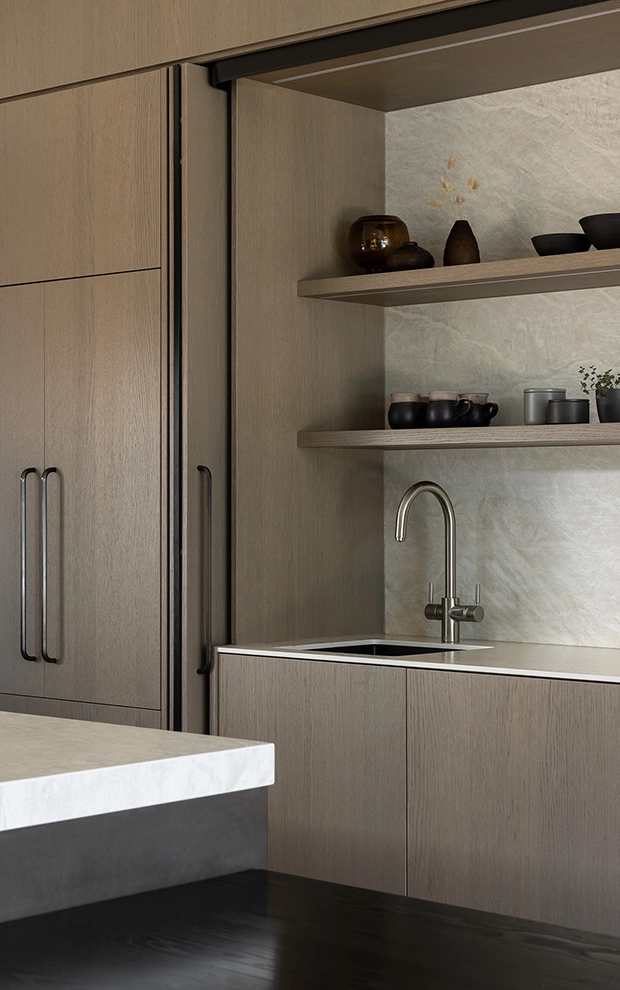
Designed with versatility in mind, our prefinished timber veneer panels are ideal for a myriad of interior applications. Whether you're creating curved details, integrated kitchen joinery or looking for wall & ceiling linings, explore our world of options.


To order a sample of any of our products, click ‘Order a Colour Sample’ on any product page. If you are an industry professional and would like to order a full sample kit please reach out to our team at hello@vidaspace.co.nz or 0800 119 388
All of our products are suitable for wall and ceiling application. Any flooring product can also be used for walls and ceilings, as well as our veneer products.
Wood veneer is very thin slices of real wood, and is produced by slicing a log in fine layers with a blade. In contrast to solid wood, which is sawn, veneer makes optimal use of the log without any sawing loss. Cutting a log can be done in various ways. Each way produces a different pattern and can be cut to various thicknesses. The standard thickness is 0.6mm or 1mm. Veneer retains the natural look and feel of real wood as well as its unique properties, showing authentic colour and pattern variations, while being a much more sustainable option to thicker or solid wood.
Most melamine or laminate panels have a design repeat. ALT™ MasterOak has no design repeat within the panel, which makes it one of the most realistic laminates on the market. Timber veneer panels do not have a pattern repeat as they are made from wood which is a natural material, although some veneer flitches can have similar grain structure.
Decorative wall panels can be installed near fireplaces or log burners, but because most are considered combustible materials, they must be installed outside the minimum clearances specified in AS/NZS 2918 and the New Zealand Building Code to ensure safe distances from heat sources.
Timber veneer is a thin slice of real wood that’s pressed onto a core, like MDF, particle board or plywood. It gives the same natural timber look while using much less material and helping reduce movement or warping over time. Because it uses less solid timber, it’s also generally considered a more sustainable option. Solid wood, on the other hand, is made entirely from natural timber all the way through. Veneer is commonly used for cabinetry and large panels because it’s more stable, cost-effective, and makes better use of valuable timber resources.
Acoustic panels are designed to absorb sound rather than reflect it. They typically use felt, foam, or fabric-covered materials that capture sound waves and reduce echo and reverberation within a room. Some panels may utilise perforation to allow sound to pass through them to an absorbent backing material.
Veneer is a thin slice of real timber applied to a substrate, while laminate is a decorative printed surface made from layered papers and resins pressed together under heat.
MDF is made from fine wood fibres compressed into a dense, smooth board. Plywood is made from thin layers of timber veneer glued together in alternating grain directions for strength. Particle board is made from wood chips and resin pressed into a board.
Some decorative panels use real wood veneer, while others use laminates or printed finishes designed to replicate wood, stone, or other textures.
Veneer panels can be used for bathroom vanities if properly sealed and installed away from direct water exposure. A good extraction system should be used, and moisture-resistant substrates are recommended.
Yes. Veneer panels are durable for interior use when properly finished and maintained, though they should be protected from excessive moisture and impact.
Timber panels can usually be cleaned with a microfibre cloth and timber specific pH neutral cleaner. Avoid harsh chemicals and excessive moisture.
Acoustic panels primarily reduce echo and reverberation within a room rather than blocking sound from travelling between rooms.
The standard panels sizes in NZ are approximately 1200mm wide x 2400-3600mm long.
It depends on the application. Wood veneer offers the authentic look and feel of real timber, while laminate provides high durability and consistent finishes.
MDF, Ply or particle board.
Veneer panels can be considered more sustainable than solid timber because a small amount of real wood is used over a substrate that is more resource efficient.
Fire ratings vary depending on the material, substrate, and surface finish. Some panels are available with tested fire performance suitable for commercial applications.


